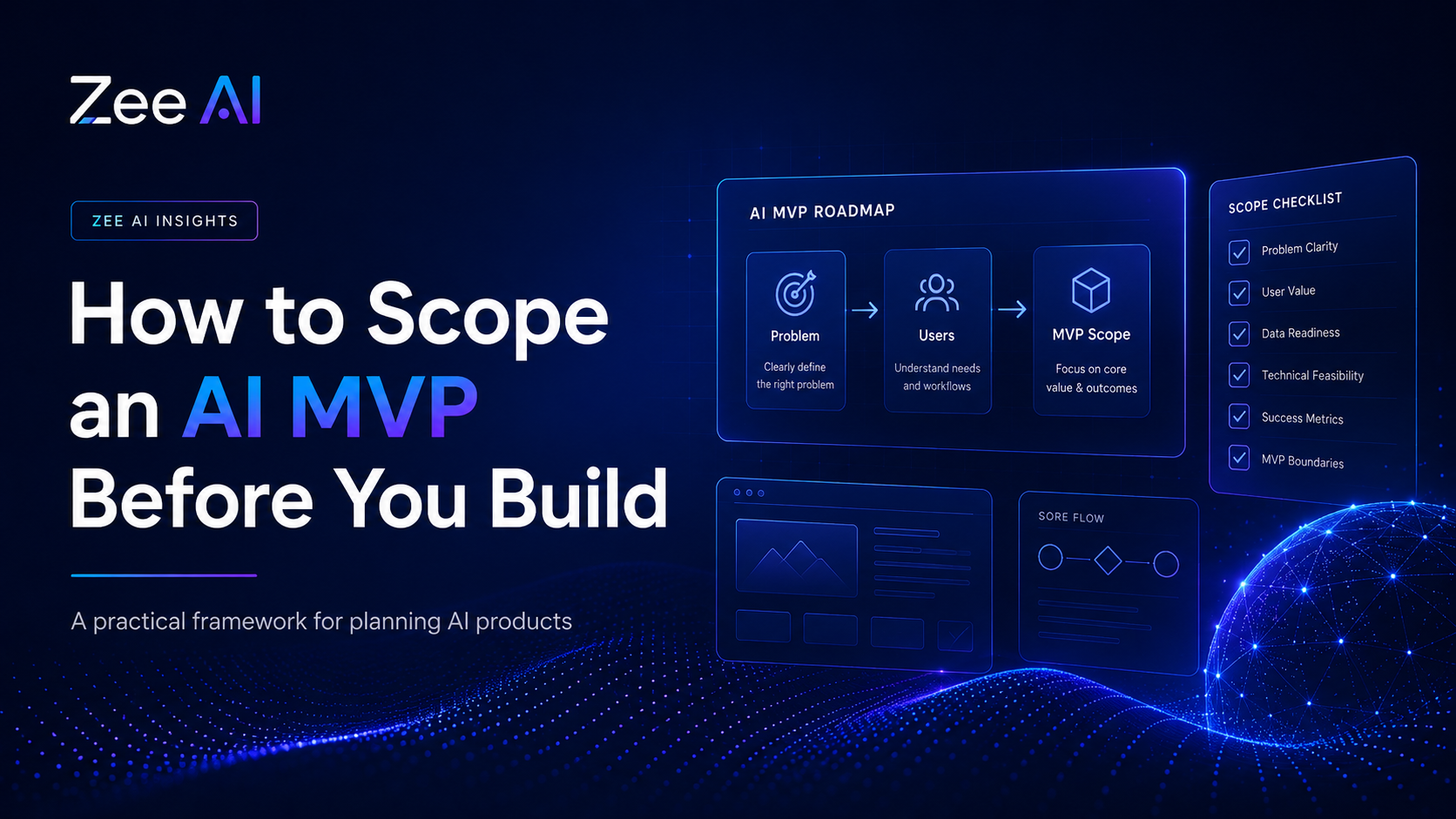
Building an AI product sounds exciting. You may imagine a smart chatbot, an AI agent, a document assistant, an automation tool, or a complete AI SaaS platform that solves a real business problem.
But before you start development, there is one important step most founders and businesses skip: scoping the AI MVP.
An AI MVP, or Minimum Viable Product, is not the smallest version of your idea. It is the smallest useful version that proves whether your AI solution can solve a real problem for real users.
If you scope your AI MVP correctly, you save time, reduce development costs, avoid unnecessary features, and launch faster. If you skip scoping, you may spend weeks or months building an AI product that is too complex, too expensive, or not useful enough for customers.
This guide explains how to scope an AI MVP before you build, especially if you are planning an AI chatbot, AI agent, RAG-based assistant, automation system, or custom AI web app.
What Is an AI MVP?
An AI MVP is the first working version of an artificial intelligence product that focuses on one clear use case.
It should include only the essential features needed to test the product idea, user experience, AI performance, and business value.
For example, instead of building a complete AI customer support platform, your MVP could be:
- A chatbot that answers questions from your FAQ and policy documents
- A RAG assistant that searches internal company knowledge
- An AI agent that creates support ticket summaries
- An automation tool that extracts information from customer emails
- A simple AI web app that generates reports from uploaded documents
The goal is not to build everything. The goal is to prove that the core AI workflow works.
Why AI MVP Scoping Matters
AI products are different from normal software products. Traditional apps usually follow fixed rules. AI systems depend on prompts, data quality, model behavior, user input, integrations, and evaluation.
That means poor planning can quickly create problems such as inaccurate responses, high API costs, slow performance, confusing user experience, or features that are difficult to maintain.
Scoping helps you answer important questions before development starts:
- What exact problem will the AI solve?
- Who will use it?
- What data will it need?
- Which tasks should AI handle?
- What should remain manual?
- How accurate does the system need to be?
- What integrations are required?
- How will success be measured?
A well-scoped AI MVP turns a broad idea into a clear build plan.
Step 1: Define One Core Problem
The first step is to define the main problem your AI MVP will solve.
Avoid starting with a broad idea like “we want an AI assistant for our business.” That is too general. Instead, identify one specific pain point.
Better examples include:
- “We need an AI chatbot that answers customer questions from our website content.”
- “We need an AI agent that summarizes sales calls and updates CRM notes.”
- “We need a document assistant that helps employees search company policies.”
- “We need an automation system that reads order emails and extracts delivery details.”
The clearer the problem, the easier it becomes to design the MVP.
A good AI MVP problem should be frequent, time-consuming, measurable, and valuable enough that users care about solving it.
Step 2: Identify the Target User
Next, define who will use the AI MVP.
Different users need different workflows. A founder, customer support agent, student, sales team, doctor, restaurant owner, or operations manager will not use the same AI product in the same way.
Ask these questions:
- Who is the main user?
- What task do they perform today?
- What makes that task slow or difficult?
- Where does the AI fit into their workflow?
- What result do they expect from the AI?
For example, if your target user is a customer support team, the AI MVP may need fast answers, source references, escalation options, and admin control.
If your target user is a business owner, they may care more about reports, automation, cost savings, and simple dashboards.
Step 3: Map the Current Workflow
Before building an AI solution, understand the existing workflow.
Write down how the task is currently done from start to finish. Then identify where AI can reduce effort, improve speed, or increase quality.
For example, a manual customer support workflow may look like this:
- Customer asks a question
- Support agent reads the message
- Agent searches company documents
- Agent writes a response
- Agent sends the answer
- Agent updates ticket status
An AI MVP could improve this workflow by generating suggested answers from approved documents. The human agent can review and send the final response.
This is often better than trying to fully automate everything from day one.
Step 4: Choose the Right AI Capability
Not every AI MVP needs the same type of AI system. Choosing the right AI capability helps control cost and complexity.
Common AI MVP types include:
For many businesses, a RAG-based AI assistant is a strong first MVP because it can answer questions using company-specific documents instead of relying only on general model knowledge.
Step 5: Define the Data Sources
AI performance depends heavily on data.
Before you build, list the data your MVP will use. This may include website pages, PDFs, FAQs, product documents, support tickets, CRM data, spreadsheets, manuals, emails, or internal knowledge bases.
For each data source, check:
- Is the data available?
- Is it accurate and updated?
- Is it structured or messy?
- Does it contain sensitive information?
- Does the AI need to cite sources?
- How often will the data change?
If your AI MVP uses poor data, the final output will also be poor. Clean and relevant data is one of the most important parts of AI MVP success.
Step 6: Decide What the MVP Will Not Do
A strong MVP scope includes exclusions.
This means you should clearly define what the first version will not include.
For example, your AI chatbot MVP may not include:
- Voice support
- Mobile app
- Multiple languages
- Advanced analytics
- Complex admin roles
- Payment system
- Full CRM integration
- Autonomous decision-making
These features can be added later. The first version should focus on proving the core use case.
This keeps the AI MVP simple, affordable, and faster to launch.
Step 7: Set Success Metrics
Before building, define how you will measure success.
AI MVP success should not be based only on whether the product “looks good.” It should be based on measurable business value.
Useful AI MVP metrics include:
- Time saved per task
- Percentage of questions answered correctly
- Reduction in manual work
- User satisfaction score
- Number of successful AI interactions
- Cost per AI response
- Lead conversion improvement
- Support ticket reduction
- Accuracy of extracted data
- Number of users who return to use the tool again
For example, if you are building an AI customer support chatbot, a useful metric could be: “The chatbot should correctly answer at least 70% of common customer questions using approved knowledge sources.”
Step 8: Plan Human Review and Safety
AI does not need to handle everything automatically in the MVP stage.
For many businesses, the best first version is human-in-the-loop. This means AI prepares the response, summary, recommendation, or extracted data, and a human reviews it before final action.
This is especially important for sensitive areas like healthcare, finance, legal, education, hiring, or customer complaints.
AI MVP safety planning should include:
- Clear limitations
- Escalation to a human
- Source citations where possible
- User feedback options
- Restricted actions for AI agents
- Data privacy rules
- Logging and monitoring
A safe MVP builds trust and reduces risk.
Step 9: Estimate Budget, Timeline, and API Costs
AI MVP cost depends on the scope, features, integrations, model usage, hosting, data processing, and user volume.
Before development begins, estimate:
- Development cost
- Model/API cost
- Vector database cost
- Hosting cost
- Maintenance cost
- Future scaling cost
A simple AI chatbot MVP may be much cheaper and faster than a full AI agent platform with multiple integrations.
The goal is to start lean, validate demand, and improve based on real usage.
Step 10: Turn the Scope Into a Build Plan
Once the AI MVP is scoped, convert it into a simple development plan.
Your plan should include:
- Main use case
- Target users
- Core features
- Data sources
- AI model approach
- Integrations
- User interface screens
- Admin requirements
- Success metrics
- Testing plan
- Launch timeline
This document becomes the roadmap for designers, developers, AI engineers, and business stakeholders.
AI MVP Scoping Checklist
Before building your AI MVP, make sure you can answer these questions:
- What problem are we solving?
- Who is the main user?
- What task will AI improve?
- What data will the AI use?
- Do we need a chatbot, RAG assistant, AI agent, or automation system?
- What features are essential for version one?
- What features should wait until later?
- What does success look like?
- How will we test AI quality?
- What human review is needed?
- What is the expected budget and timeline?
- How will the product scale after validation?
If you cannot answer these questions yet, your AI MVP is not ready to build.
Common Mistakes to Avoid
Many AI MVPs fail because the first version is too broad. Businesses try to build a complete AI platform before proving one use case.
Avoid these common mistakes:
- Building too many features in version one
- Using AI without a clear business problem
- Ignoring data quality
- Skipping user workflow analysis
- Not measuring AI accuracy
- Forgetting API and hosting costs
- Expecting AI to be perfect immediately
- Launching without human review
- Not collecting feedback from real users
A focused MVP has a much higher chance of success than a complex first launch.
Final Thoughts
Scoping an AI MVP before you build is one of the smartest decisions a business can make.
It helps you move from a broad AI idea to a clear, testable, and practical product plan. Whether you are building an AI chatbot, AI agent, RAG assistant, automation workflow, or custom AI SaaS product, the right scope will save time, reduce costs, and improve your chances of success.
At Zee AI, we help businesses plan, design, and build practical AI MVPs that solve real problems. Our focus is on creating intelligent systems that are simple to use, scalable, and aligned with business goals.
If you are planning to build an AI MVP, start with the scope first. The better your scope, the better your product.